A special time of the month is coming. Time to rummage the wallets, purses, bags and garbage bins for receipt slips from shops and stores. Time to painstakingly check the numbers on dozens or hundreds of the slips, hoping for a positive match. Time to dream about the exotic vacations in a faraway land. Six times a year, this is what we do here. The lucky ones get 200 NTD out of all that, the less lucky ones go over the slip numbers once again, thinking they must have missed something, read the number wrong. The winning ticket must be somewhere in the pile!
What am I talking about? It is a well-kept secret for many newcomers to Taiwan that all official receipt slips are involved in a government lottery. Every two months, winning numbers are announced. Whoever finds that the eight-digit number on their slip matches the winning number, walks away with 2 million NTD. Only a partial match carries lower prize money. Last three matching digits mean winning 200 NTD. I've played the game twice. Collected 60 or 70 slips. Didn't win anything on either occasion, despite using modern technology (MS Excel) to make sure I didn't miss anything. Sure, the odds were against me - 3 three-digit combinations, out of a thousand possibilities, mean that only one ticket in 333 wins. I think I'm almost due my (200 NTD) payday. I've heard of people who have done it. One friend won 4000 dollars once.. But that was karma giving him a small reconciliation as he had been robbed of 8000 dollars one week prior to that.
Tuesday, 24 March 2009

Tuesday, 17 March 2009
Where do I live?
We've been living in our apartment and furnishing it for over two months. We finally decided it was about ready (keeping in mind the fact that I will only live here for a year and a bit more and it is not very practical to bring all the equipment back to Europe), and it was time to celebrate the fact with a housewarming party this Saturday. The doorman watching the entrance was a little concerned when I announced it to him, perhaps worried about a party full of foreigners - we as foreign people, young ones especially, don't have a very good reputation here in that regard. But the neighbors were not banging on the walls, neither did the police come to break the party up (apparently, that happens here. The neighbors don't come to ask you to be quiet, they just call the cops straight away)
Anyways, it was a very successful event. We had 17 guests from 4 continents and 8 countries (Canada, Chile, Czech Republic, England, Finland, Germany, Slovakia, Taiwan) Here we are:

I spent almost 2 months looking for a place last fall, and it paid off, as the place is the biggest I've seen, though the price is the same. Surprisingly, we haven't found any serious flaws that would justify the low price. Sure we have seen a cockroach or two, experienced a little flood and found weird fungus growing on the furniture upon returning from the Philippines, but that seems to be a rather normal thing in Taiwan. The devices to kill insects and drive mold away are readily available and the plumber got here on a very short notice during the flood (and the landlady paid for his services). Anyways, we have three floors: Here's the first - kitchen / living room

And the second floor, kind of a working area. Also big enough to dance, put together large puzzles, accommodate guests and so on.

Third floor is just big enough for a bed. Instead, below is a view from our balcony. A view like this is pretty rare in densely populated Taipei. Luckily, we are at the very edge of the city, at the foot of the mountains. This is not very convenient for most people, but perfect for us, seeing as the university is only 10 minutes' walk away.

The apartment is also fairly hi-tech equipped. Best example of that is the toilet, which has about 5 different buttons on the side, as well as many lights which flash, turn on and off at various times and so on. Said toilet, especially its bidet function received a lot of attention from the guests to our party.
Anyways, it was a very successful event. We had 17 guests from 4 continents and 8 countries (Canada, Chile, Czech Republic, England, Finland, Germany, Slovakia, Taiwan) Here we are:

I spent almost 2 months looking for a place last fall, and it paid off, as the place is the biggest I've seen, though the price is the same. Surprisingly, we haven't found any serious flaws that would justify the low price. Sure we have seen a cockroach or two, experienced a little flood and found weird fungus growing on the furniture upon returning from the Philippines, but that seems to be a rather normal thing in Taiwan. The devices to kill insects and drive mold away are readily available and the plumber got here on a very short notice during the flood (and the landlady paid for his services). Anyways, we have three floors: Here's the first - kitchen / living room

And the second floor, kind of a working area. Also big enough to dance, put together large puzzles, accommodate guests and so on.

Third floor is just big enough for a bed. Instead, below is a view from our balcony. A view like this is pretty rare in densely populated Taipei. Luckily, we are at the very edge of the city, at the foot of the mountains. This is not very convenient for most people, but perfect for us, seeing as the university is only 10 minutes' walk away.

The apartment is also fairly hi-tech equipped. Best example of that is the toilet, which has about 5 different buttons on the side, as well as many lights which flash, turn on and off at various times and so on. Said toilet, especially its bidet function received a lot of attention from the guests to our party.
Thursday, 12 March 2009
Awkward bits and funny bits
I can't believe it's only the third week of classes. I didn't expect to be this busy with school until June. However, one of my classes is intensive, because the professor is from the States and only staying in Taiwan for several months. In fact, there class will be over in 2 weeks, and that's also when the term paper is due.
I went to the gym earlier today. Of the people there, there was one girl performing some high-level taichi, two girls performing a lower level aikido and a whole bunch of guys lifting weights. Strange thing about those guys, about half of them was wearing jeans. In fact, every time I go to the gym, I see many Taiwanese guys exercising there in jeans. With an exception of tuxedo or a rain coat, I can't think of worse clothes to work out in. I also have to add that several other guys in the gym were walking around without a t-shirt. They spend most of the time checking out their bulging muscles in the mirrors. To make things even more awkward, I passed a football field on the way home, with at least 40 or 50 people on the field, playing football. It was pretty crowded.
As announced earlier, I bought my plane tickets home. I will arrive in Prague on June 18 and go back to Taiwan on September 8. The best deal I could find anywhere was flying with KLM, Taipei to Prague with a short stopover in Amsterdam, for 30 000 NTD (this is some "early bird" special price), so I bought a ticket. I was a little annoyed when just yesterday, I checked their website again out of curiosity, and saw exactly the same ticket for 26 500 NTD. Oh well.
Since I'm a media student now, I've been paying increasing attention to news stories about Taiwan in the Czech media. The job is pretty simple, as there is approximately 1 story per 2 months. As far as I remember, the last one was some time in December, I even wrote a blog post about it. Just recently, another story came out. Any wild guesses what it might be about?
It's about the famous toilet-themed restaurant in Taipei. See the report here.
Finally, one thing I haven't had here yet, are Taiwanese jokes. Here is a couple.
Disclaimer: If you're not fluent in Chinese, you probably won't understand them :) No worries, they are not too funny anyways.
--------------------------------
First joke is a little political. Deng Xiao Ping (the former leader of the Communist party in Mainland China) arrives in the United States for the first time. American journalists are already waiting for him with their questions.
First, they want to test whether he has any knowledge about the country he just arrived in: So they ask him: Do you know what is the capital of the United States?
The poor man doesn't know a word of English. However, he assumes that, like in China, the first question people ask each other is what their name is. So he replies: 我姓邓.
Very good, think the journalists. He's done his homework. They question further. Your wife isn't here with you, where is she?
Mr. Deng hasn't completed the introduction yet, so he answers: 小平.
Oh, you wife went shopping! Say the journalists. How did she go?
Mr. Deng really doesn't know what they are asking him, so he thinks of other common questions people ask each other in China. "They probably want to know my age", he finally concludes.
"八十"
Ah, the wife went shopping by bus, understand the journalists. At this point, they want to go to some serious news reporting, so they ask questions about Taiwan. "Mr. Deng, who do you think will be the next president of Taiwan?"等會!
The journalists write down the prediction. 李登輝 will be the next president of Taiwan. And they want to know more: What about the next one, after 登輝? Who will be the president?
Deng doesn't want to deal with these reporters any more. Whatever, he wants to tell them. 隨便!
Hahaha, wasn't that a wonderful joke? Here's another one, equally potent, but at least considerably shorter. A taxi driver told me this one.
Q: What color is spiderman?
A: White.
蜘蛛人是什麽顔色?
是白的人。
I went to the gym earlier today. Of the people there, there was one girl performing some high-level taichi, two girls performing a lower level aikido and a whole bunch of guys lifting weights. Strange thing about those guys, about half of them was wearing jeans. In fact, every time I go to the gym, I see many Taiwanese guys exercising there in jeans. With an exception of tuxedo or a rain coat, I can't think of worse clothes to work out in. I also have to add that several other guys in the gym were walking around without a t-shirt. They spend most of the time checking out their bulging muscles in the mirrors. To make things even more awkward, I passed a football field on the way home, with at least 40 or 50 people on the field, playing football. It was pretty crowded.
As announced earlier, I bought my plane tickets home. I will arrive in Prague on June 18 and go back to Taiwan on September 8. The best deal I could find anywhere was flying with KLM, Taipei to Prague with a short stopover in Amsterdam, for 30 000 NTD (this is some "early bird" special price), so I bought a ticket. I was a little annoyed when just yesterday, I checked their website again out of curiosity, and saw exactly the same ticket for 26 500 NTD. Oh well.
Since I'm a media student now, I've been paying increasing attention to news stories about Taiwan in the Czech media. The job is pretty simple, as there is approximately 1 story per 2 months. As far as I remember, the last one was some time in December, I even wrote a blog post about it. Just recently, another story came out. Any wild guesses what it might be about?
It's about the famous toilet-themed restaurant in Taipei. See the report here.
Finally, one thing I haven't had here yet, are Taiwanese jokes. Here is a couple.
Disclaimer: If you're not fluent in Chinese, you probably won't understand them :) No worries, they are not too funny anyways.
--------------------------------
First joke is a little political. Deng Xiao Ping (the former leader of the Communist party in Mainland China) arrives in the United States for the first time. American journalists are already waiting for him with their questions.
First, they want to test whether he has any knowledge about the country he just arrived in: So they ask him: Do you know what is the capital of the United States?
The poor man doesn't know a word of English. However, he assumes that, like in China, the first question people ask each other is what their name is. So he replies: 我姓邓.
Very good, think the journalists. He's done his homework. They question further. Your wife isn't here with you, where is she?
Mr. Deng hasn't completed the introduction yet, so he answers: 小平.
Oh, you wife went shopping! Say the journalists. How did she go?
Mr. Deng really doesn't know what they are asking him, so he thinks of other common questions people ask each other in China. "They probably want to know my age", he finally concludes.
"八十"
Ah, the wife went shopping by bus, understand the journalists. At this point, they want to go to some serious news reporting, so they ask questions about Taiwan. "Mr. Deng, who do you think will be the next president of Taiwan?"等會!
The journalists write down the prediction. 李登輝 will be the next president of Taiwan. And they want to know more: What about the next one, after 登輝? Who will be the president?
Deng doesn't want to deal with these reporters any more. Whatever, he wants to tell them. 隨便!
Hahaha, wasn't that a wonderful joke? Here's another one, equally potent, but at least considerably shorter. A taxi driver told me this one.
Q: What color is spiderman?
A: White.
蜘蛛人是什麽顔色?
是白的人。
Friday, 6 March 2009
The weekend
Today, I'm going to mix things up a bit.
Tänään kirjoitan Suomea. Miksi? Suomi on vaikea kieli. Osaan jo vähän Suomea, mutta haluan harjoitella.
Mitä teen viikonloppuna? Lauantaina nousen myohään, koska en mene yliopistolle. Nooran kanssa syömme aamiaista. Syömme leipää, hilloa, jogurttia ja kurkkua, juomme teetä ja maitoa. Ilma on huono. Se on sateinen ja kylmä, niin että jäämme kotiin. Minä luen kirjaa ja kirjoitan, tyttöystäväni myös kirjoitaa.
Laitamme illallista sitten. Illalla katsomme televisiota tai pelaamme tietokonepelejä. Sunnuntaina aamupäivällä teemme pannukakkua. Syömme mielellämme pannukakkua. Sitten menemme kauppaan. Kaupasta ostamme asuntoon esineitä. Se on todella hyvä viikonloppu.
Don't freak out, considering how long it took me to write these few sentences, even with substantial help from Noora, It will be a while before I attempt another post like this again.
Tänään kirjoitan Suomea. Miksi? Suomi on vaikea kieli. Osaan jo vähän Suomea, mutta haluan harjoitella.
Mitä teen viikonloppuna? Lauantaina nousen myohään, koska en mene yliopistolle. Nooran kanssa syömme aamiaista. Syömme leipää, hilloa, jogurttia ja kurkkua, juomme teetä ja maitoa. Ilma on huono. Se on sateinen ja kylmä, niin että jäämme kotiin. Minä luen kirjaa ja kirjoitan, tyttöystäväni myös kirjoitaa.
Laitamme illallista sitten. Illalla katsomme televisiota tai pelaamme tietokonepelejä. Sunnuntaina aamupäivällä teemme pannukakkua. Syömme mielellämme pannukakkua. Sitten menemme kauppaan. Kaupasta ostamme asuntoon esineitä. Se on todella hyvä viikonloppu.
Don't freak out, considering how long it took me to write these few sentences, even with substantial help from Noora, It will be a while before I attempt another post like this again.
Monday, 2 March 2009
Back in Business
First week of the second semester is over, so I'm back to my boring normal Taiwanese life. I spent last week going to different classes and deciding which ones to take and which ones to drop. While many people around me are basing the decision almost entirely on the amount of work required to pass each class (and choosing the classes with the least amount, obviously), this has only played a partial role in my choosing. The other big and important aspect is, when will the class be finished and will it allow me to get out of Taiwan by the middle of June to go back to Europe? So far it seems that my efforts have been successful, I am planning to buy my ticket within the next few days. The date of my return will be announced soon, so that my fans can get ready to come welcome me at the airport :) It will be a return ticket though, I'm still coming back to Taiwan in the fall.
The classes I will be taking this semester are:
Mainland China Communication Studies
Media and Globalization
Political Communication
Human Communication
I expect this to be an interesting mix of a lecture class, research-oriented class, discussion class and a fun class. The professor for the fun class (a Taiwanese woman) had a nice surprise for me, welcoming me with an Ahoj!, as her husband is Czech. Only minutes later, we were cracking inside jokes about mathematicians, as her husband used to study at the Department of Maths and Physics at the Charles University in Prague, as did my brother and his soon-to-be-wife did. (neber si to moc osobně, Oldo.)
This also means that unfortunately, I won't be able to take the by-far-most-interesting class on offer this semester, A Journey Into The World Of Chinese Opera. The class will study the singing, the make-up, it will visit several opera performances and the students will even get to perform some opera themselves.
Grades for the previous semester are also out, and I'm satisfied. The only one that has caused a little confusion among foreign students is a "Morality grade". As Ryan found out for the rest of us, it is a local tradition to grade students on morality. Quite awkward by itself, but it gets really weird upon the discovery that every single student at the university gets a 85% morality grade. Everyone, every semester. And that the grades might be determined by a professor I've met maybe twice in my life. A rumor says that doing something exceptionally good, or something really bad, would cause a change in the grade. The fact that this grade goes on the official transcript may mean complicated explanations to future employers, unaware that being 85% moral is as good as it gets in Taiwan. I can only hope they will put it on in Chinese, hence saving me from the complicated explanations.
The classes I will be taking this semester are:
Mainland China Communication Studies
Media and Globalization
Political Communication
Human Communication
I expect this to be an interesting mix of a lecture class, research-oriented class, discussion class and a fun class. The professor for the fun class (a Taiwanese woman) had a nice surprise for me, welcoming me with an Ahoj!, as her husband is Czech. Only minutes later, we were cracking inside jokes about mathematicians, as her husband used to study at the Department of Maths and Physics at the Charles University in Prague, as did my brother and his soon-to-be-wife did. (neber si to moc osobně, Oldo.)
This also means that unfortunately, I won't be able to take the by-far-most-interesting class on offer this semester, A Journey Into The World Of Chinese Opera. The class will study the singing, the make-up, it will visit several opera performances and the students will even get to perform some opera themselves.
Grades for the previous semester are also out, and I'm satisfied. The only one that has caused a little confusion among foreign students is a "Morality grade". As Ryan found out for the rest of us, it is a local tradition to grade students on morality. Quite awkward by itself, but it gets really weird upon the discovery that every single student at the university gets a 85% morality grade. Everyone, every semester. And that the grades might be determined by a professor I've met maybe twice in my life. A rumor says that doing something exceptionally good, or something really bad, would cause a change in the grade. The fact that this grade goes on the official transcript may mean complicated explanations to future employers, unaware that being 85% moral is as good as it gets in Taiwan. I can only hope they will put it on in Chinese, hence saving me from the complicated explanations.
Sunday, 22 February 2009
South & Central Taiwan + Taiwan facts and observations, part IV.
Following a brief rest after the exhausting vacation in the Philippines, we decided to make a good use of the time before classes start again and explore the South and Central parts of Taiwan a bit. Seeing that for the first 4 months of my stay here, I've only been around the Northernmost 10% of the island area, it was about high time to do that. Scattered through the post are some more of the popular Taiwan facts and observations.
So we took off on a Friday morning from Taipei to Taiwan's second largest town, Kaohsiung, which is situated at the very South of the island. The choice of transportation is enormous, from a slow train (7 hours), to a fast train (4 hours) to the new high-speed railway (1,5 hours), and a myriad of bus companies. Somehow, we managed to choose probably the most luxurious bus, which only fitted about 20 passengers. (compare that with the El Nido - Puerto Princesa bus in the Philippines, which was half the size, yet fit about 60 passengers) Each passenger gets to sit in an enormous armchair, with a private TV screen and a selection of about 20 TV channels (the only English channel played 3 bad movies during the trip), with a bus attendant who came by about every 15 minutes to offer us water, tea, coffee and biscuits. It wasn't even that expensive, and took about 5 hours. We drove through the Western lowlands, which are densely inhabited, saw a lot of concrete buildings, rice paddies, huge rivers with no water in them, and the mountains (covering the central and western part of the island) in the distance.
Kaohsiung is a big city, whose major attraction include a tall building, busy sea harbor, a river called the Love River (good thing we came a day before the Valentine's day), malls and a night market. Sounds familiar, doesn't it? We got to see some neat fireworks over the love river, apparently marking the end of the Chinese New Year celebrations.

also visited one of many night markets, experimented with the local drinks - like a bamboo juice, and a local version of the pineapple juice - both of them were pretty horrible. Fortunately, the food was much better - like the dim sum on the picture below. Dim sum is a Hongkongese (Cantonese) specialty, dozens of sorts of these small dumplings with a variety of fillings and flavors.

The next day, we joined hordes of locals on a peaceful stroll around the Lotus pond, a lake on the ourskirts of the city. This is a pretty typical Taiwanese recreation area, as it is surrounded by a number of entertainment options (of the fair sort), temples and buildings so typical for any "Chinese" country. The Dragon and Tiger pagodas, which are actually guarded by huge statues of a dragon and a tiger. For good luck, one must enter the complex through the mouth of the dragon and exit it through the tiger. I wasn't able to find out what kind of curse is connected with doing it the other way round.

Just few steps further is this enormous statue of some Chinese god (there are too many of them to be able to tell which one it is). There is a temple inside the statue, and a pond full of turtles outside.

Next stop after Kaohsiung was the nearby city of Tainan, which is said to be the oldest city and a former capital of Taiwan, and currently the fourth largest city. Tainan is apparently famous for its temples and a "unique psyche and atmosphere". Frankly, I haven't noticed any unique atmosphere about the city - same busy roads, same noodle stalls, same Japanese deparment store. Despite it being rather old (maybe 400 years, which is nothing by European standards), it doesn't feel that way, and is actually a modern city with the occasional historical relics scattered around.
Speaking of Tainan, the person who came up with the names of Taiwanese cities must have been someone with a serious lack of imagination. Why?
We live in Tai wan. 台灣
The big city in the north is Tai bei. Bei = north. 台北
The big city in the south is Tai nan. Nan = south 台南
The big city in the east is Tai dong. Dong = east 台東
The big city in the center is Tai zhong. Zhong = center 台中
Does anybody know whether a city called 台西 also exists?
So, upon arrival in Tainan, we set off for the tour of the local temples. Let me tell you something about the Chinese temples. The first visit to one is wonderful. It's all so new, interesting and colorful. The second and third ones are still fun. After that, every other temple seems and feels the same to the average foreigner, ignorant of the fact that this particular temple is the oldest temple dedicated to Matsu, the goddess of the sea.
Anyways, for a brief intro (from my uneducated perspective), temples are mostly Taoist, Budhist, or "Animist" (dedicated to the older, natural religions). They are pretty difficult to tell apart and often actually contains bits of more than one religions.
Some of the things that do happen at a Taiwanese temple:

Also in Tainan, we ran into a "gathering of puppet fans". I've heard of this before, but never had the chance to witness it with my own eyes. What is this then? There are these Taiwanese (probably) puppets (see below), and a subculture of people, who love them. I don't know whether the puppets are used just a decoration, or to play theater with, or whether they have some old, deep meaning. Several times though, I've seen a TV show featuring these - like a cartoon, except the characters are not animated. Anyways, so we came into a little park with a pond in the middle, and around it, there were dozens of people, carrying around these puppets, chatting about them, arranging them in a variety of settings and taking pictures of them.

Some people take it to the next level, so to speak, and actually dress themselves up as their puppet heroes, parade around in these wonderful costumes and take loads of pictures.

Next stop on the trip was Fenqihu, on the way to Alishan. The Alishan area is one of the most popular tourist destinations in Taiwan. The village lies at the altitude of about 2200 meters, and is surrounded by much higher mountain peaks. Apparently, it is famous for neat sun rises, cherry trees and a train that goes up there. The train has been around for about 100 years and travels from an altitude of 30 meters, all the way up to 2200, in about 4 hours, which apparently makes it one of only 3 trains in the world to do something like that. The ride was nice, but at the end of the day, just a train ride. I suppose all the unique things about it are appreciated mostly by the train freaks, the rest of us just don't see the magnitude.

Anyways, Fenqihu is a nice village in the mountains, surrounded by the forests and some nice walking trails. We stayed at a hostel run by the local catholic church (how did that get there?), operated by a missionary from Poland and two very old nuns, one from Germany, the other one from Switzerland. The Polish guy surprised me by speaking very good Slovak, and the two very old nuns in turn shocked by their fluent Chinese.

After a few days in the mountains, we headed back to Taipei. On the way, we finally got to see one of Taiwan's most remarkable sights. The Binlang xishi, or Betel nut beauties. For a brief background, the Betel nut is a seed of some tree which, when chewed, has stimulating effects, much like caffeine for example. Chewing the nuts is popular among many Taiwanese, truck drivers in particular, and the nuts are widely available. At some point, a clever businessman realized the simple truth that most truck drivers are men, and that men are drawn by young, attractive women with revealing clothing. It was only a short step from there to establishing glass booths on roadsides, inside which said young and attractive girls with little clothing on sit and sell the betel nuts. The trend spread quickly until the booth were all over Taiwan and the Binlang girl was a universally known phenomenon. To the uneducated eye, this may look very much like Amsterdam's red light district, and indeed many foreigners at first assume that the girls are actually prostitutes.
Unfortunately, some more prudent city councils (like Taipei) didn't like these booths, so they simply prohibited them. That's why no betel nut girls can be seen in Taipei. It seems that the trend is on a decline, as we haven't seen too many of them even in the south, but they were there nevertheless. I don't have any good pictures of my own, so I borrowed this one from a betelnut girl fan discussion board (yep, they have that!).

One last random Taiwanese fact to share: They have a different way of telling the age here. Therefore, a person who is 20 years old by the Western counting will claim to be 21 years old here. Why? Apparently, the counting of age starts at one, i.e. when a child is born, it is one year old, not zero years old like we say everywhere else.
On top of all, my identity has changed quite a bit in Taiwan. I just received my National health insurance card. The only name it says on it is: 楊伯瑞. And the date of birth says 74/01/23. I'm suddenly 35 years old now! Of course this is just because of the Taiwanese calendar, in which 1911 was year 0, but I'm afraid I can't use the card as a valid ID anywhere outside Taiwan. It will be handy if I ever need to get into some establishment which only admits people over 30 though.
So we took off on a Friday morning from Taipei to Taiwan's second largest town, Kaohsiung, which is situated at the very South of the island. The choice of transportation is enormous, from a slow train (7 hours), to a fast train (4 hours) to the new high-speed railway (1,5 hours), and a myriad of bus companies. Somehow, we managed to choose probably the most luxurious bus, which only fitted about 20 passengers. (compare that with the El Nido - Puerto Princesa bus in the Philippines, which was half the size, yet fit about 60 passengers) Each passenger gets to sit in an enormous armchair, with a private TV screen and a selection of about 20 TV channels (the only English channel played 3 bad movies during the trip), with a bus attendant who came by about every 15 minutes to offer us water, tea, coffee and biscuits. It wasn't even that expensive, and took about 5 hours. We drove through the Western lowlands, which are densely inhabited, saw a lot of concrete buildings, rice paddies, huge rivers with no water in them, and the mountains (covering the central and western part of the island) in the distance.
Kaohsiung is a big city, whose major attraction include a tall building, busy sea harbor, a river called the Love River (good thing we came a day before the Valentine's day), malls and a night market. Sounds familiar, doesn't it? We got to see some neat fireworks over the love river, apparently marking the end of the Chinese New Year celebrations.

also visited one of many night markets, experimented with the local drinks - like a bamboo juice, and a local version of the pineapple juice - both of them were pretty horrible. Fortunately, the food was much better - like the dim sum on the picture below. Dim sum is a Hongkongese (Cantonese) specialty, dozens of sorts of these small dumplings with a variety of fillings and flavors.

The next day, we joined hordes of locals on a peaceful stroll around the Lotus pond, a lake on the ourskirts of the city. This is a pretty typical Taiwanese recreation area, as it is surrounded by a number of entertainment options (of the fair sort), temples and buildings so typical for any "Chinese" country. The Dragon and Tiger pagodas, which are actually guarded by huge statues of a dragon and a tiger. For good luck, one must enter the complex through the mouth of the dragon and exit it through the tiger. I wasn't able to find out what kind of curse is connected with doing it the other way round.

Just few steps further is this enormous statue of some Chinese god (there are too many of them to be able to tell which one it is). There is a temple inside the statue, and a pond full of turtles outside.

Next stop after Kaohsiung was the nearby city of Tainan, which is said to be the oldest city and a former capital of Taiwan, and currently the fourth largest city. Tainan is apparently famous for its temples and a "unique psyche and atmosphere". Frankly, I haven't noticed any unique atmosphere about the city - same busy roads, same noodle stalls, same Japanese deparment store. Despite it being rather old (maybe 400 years, which is nothing by European standards), it doesn't feel that way, and is actually a modern city with the occasional historical relics scattered around.
Speaking of Tainan, the person who came up with the names of Taiwanese cities must have been someone with a serious lack of imagination. Why?
We live in Tai wan. 台灣
The big city in the north is Tai bei. Bei = north. 台北
The big city in the south is Tai nan. Nan = south 台南
The big city in the east is Tai dong. Dong = east 台東
The big city in the center is Tai zhong. Zhong = center 台中
Does anybody know whether a city called 台西 also exists?
So, upon arrival in Tainan, we set off for the tour of the local temples. Let me tell you something about the Chinese temples. The first visit to one is wonderful. It's all so new, interesting and colorful. The second and third ones are still fun. After that, every other temple seems and feels the same to the average foreigner, ignorant of the fact that this particular temple is the oldest temple dedicated to Matsu, the goddess of the sea.
Anyways, for a brief intro (from my uneducated perspective), temples are mostly Taoist, Budhist, or "Animist" (dedicated to the older, natural religions). They are pretty difficult to tell apart and often actually contains bits of more than one religions.
Some of the things that do happen at a Taiwanese temple:
- People light up incense sticks and bow with them in front of various god statues, making wishes
- Temples contain furnaces, where visitors burn "ghost money", yellow bits of paper, burning of which is supposed to make the ancestors rich in afterlife and therefore happy.
- Fortune-telling in one of several methods.
- Visitors can also write a wish on a little yellow plaque and leave it in the temple to have good luck during the event (many of them ask for good luck with the TOEFL, TOEIC, GMAT..)
- In order to keep the gods happy, food and drinks are placed on the altar. Normally fruits, but bottled fruit and instant noodles (uncooked, still in the plastic bowl) are also seen.
- Celebrations are particularly big around the Chinese new year. Many temples are now decorated by cows (actually, oxes) as we are currently in the year of the ox. People walk through the "tunnel" in the picture, then pet both cows.
- Other than that, the atmosphere in the temples is pretty relaxed. People watch TV, read newspaper, chat, children play around.

Also in Tainan, we ran into a "gathering of puppet fans". I've heard of this before, but never had the chance to witness it with my own eyes. What is this then? There are these Taiwanese (probably) puppets (see below), and a subculture of people, who love them. I don't know whether the puppets are used just a decoration, or to play theater with, or whether they have some old, deep meaning. Several times though, I've seen a TV show featuring these - like a cartoon, except the characters are not animated. Anyways, so we came into a little park with a pond in the middle, and around it, there were dozens of people, carrying around these puppets, chatting about them, arranging them in a variety of settings and taking pictures of them.

Some people take it to the next level, so to speak, and actually dress themselves up as their puppet heroes, parade around in these wonderful costumes and take loads of pictures.

Next stop on the trip was Fenqihu, on the way to Alishan. The Alishan area is one of the most popular tourist destinations in Taiwan. The village lies at the altitude of about 2200 meters, and is surrounded by much higher mountain peaks. Apparently, it is famous for neat sun rises, cherry trees and a train that goes up there. The train has been around for about 100 years and travels from an altitude of 30 meters, all the way up to 2200, in about 4 hours, which apparently makes it one of only 3 trains in the world to do something like that. The ride was nice, but at the end of the day, just a train ride. I suppose all the unique things about it are appreciated mostly by the train freaks, the rest of us just don't see the magnitude.

Anyways, Fenqihu is a nice village in the mountains, surrounded by the forests and some nice walking trails. We stayed at a hostel run by the local catholic church (how did that get there?), operated by a missionary from Poland and two very old nuns, one from Germany, the other one from Switzerland. The Polish guy surprised me by speaking very good Slovak, and the two very old nuns in turn shocked by their fluent Chinese.

After a few days in the mountains, we headed back to Taipei. On the way, we finally got to see one of Taiwan's most remarkable sights. The Binlang xishi, or Betel nut beauties. For a brief background, the Betel nut is a seed of some tree which, when chewed, has stimulating effects, much like caffeine for example. Chewing the nuts is popular among many Taiwanese, truck drivers in particular, and the nuts are widely available. At some point, a clever businessman realized the simple truth that most truck drivers are men, and that men are drawn by young, attractive women with revealing clothing. It was only a short step from there to establishing glass booths on roadsides, inside which said young and attractive girls with little clothing on sit and sell the betel nuts. The trend spread quickly until the booth were all over Taiwan and the Binlang girl was a universally known phenomenon. To the uneducated eye, this may look very much like Amsterdam's red light district, and indeed many foreigners at first assume that the girls are actually prostitutes.
Unfortunately, some more prudent city councils (like Taipei) didn't like these booths, so they simply prohibited them. That's why no betel nut girls can be seen in Taipei. It seems that the trend is on a decline, as we haven't seen too many of them even in the south, but they were there nevertheless. I don't have any good pictures of my own, so I borrowed this one from a betelnut girl fan discussion board (yep, they have that!).

One last random Taiwanese fact to share: They have a different way of telling the age here. Therefore, a person who is 20 years old by the Western counting will claim to be 21 years old here. Why? Apparently, the counting of age starts at one, i.e. when a child is born, it is one year old, not zero years old like we say everywhere else.
On top of all, my identity has changed quite a bit in Taiwan. I just received my National health insurance card. The only name it says on it is: 楊伯瑞. And the date of birth says 74/01/23. I'm suddenly 35 years old now! Of course this is just because of the Taiwanese calendar, in which 1911 was year 0, but I'm afraid I can't use the card as a valid ID anywhere outside Taiwan. It will be handy if I ever need to get into some establishment which only admits people over 30 though.
Monday, 9 February 2009
Philippines, complete and in pictures
The trip to the Philippines is over and I'm back in Taipei now. Coming back felt like returning back to the familiar and relaxed life, where I know how things work, which bus to take, and where I don't feel like a tourist any more. Taiwan somehow grew on me over these 4 months, and I don't even mind speaking Chinese and understanding only a fraction of the TV programs. It really feels like being back home.
This post will be a big picture wrap-up of the entire trip. The first two weeks of the trip, which I wrote about in the previous posts, will only be covered briefly and through the pictures. I will write more about the last week of the trip at the end of the post, by the appropriate photos.
First of all, a map of the country, with all the places we've been to highlighted in red.

We start in Manila, as the trip did. Manila traffic (not too busy at this point). Notice all the jeepneys and tricycles - more about those later.

Believe it or not, this is a decent Manila neighborhood, full of typical little shops.

The city lies by the sea. Here's Manila bay at dusk.

The sunsets here are quite famous. In this case, the picture tells very little about what the place is really like. The water stinks really bad. The baywalk is swarmed with homeless people, begging children and annoying ice-cream men playing one particular stupid song over and over again. There is a main road just a few steps away, making this an extremely noisy place. Also, the great colors of the sun are caused by the huge smog levels.

Probably one of the oldest things in Manila - a wall of some barracks of a fortress that used to stand here. It's a nice place, probably the one peaceful and quiet one we found. Manila had a pretty large fortress and historical district - most of it was destroyed during heavy bombing at the end of World War 2.

The Philippines are the largest producer of coconuts in the world. Here's a coconut shop at the side of the road.

Taal lake. It used to be a crater of a volcano. This volcano is now dead, however, the island in the middle of the lake is also a volcano, one of the smallest yet most active in the world. The island has its own crater (lake), and there is another island in that lake. An island in a lake on an island in a lake on an island. Yet again, the ambience of this place is spoiled by the omnipresent tricycle drivers. "Hello sir, Hello ma'am!" "Where are you going??" "Take a tricycle, very cheap" "Would you like to hire a boat to the volcano?"

This tiny volcano can also be found in the middle of the lake. However, it is inactive now.

Moving on from the horrors of Manila and Luzon (the main island) to remote Palawan, straight to El Nido, which I've been praising around. The village is all crammed under these towering limestone cliffs.

A view from the El Nido shore. This is Cadlao island, the first island of the Bacuit archipelago. Also, this is where we went on the kayak...
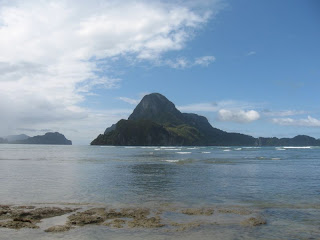
.. to that private little beach, where we were surprised by the jungle man first and those rich people later.

A boat trip to an island slightly further away. Great snorkeling around these jagged rocks.

The Big lagoon, one of the better known places to visit in the area. The huts there in the middle are the location of the Swedish Survivor reality show, which I mentioned in one of the previous posts.

To me, this picture is an perfect desription of what El Nido is.

Despite being so remote, there are relatively many tourists. El Nido itself is a place that lives almost entirely off them - the accomodation, the restaurants, boat trips, bicycle rentals, scuba diving shops. Just few minutes away, this poor fishing village is more telling about what life here is really like.

The population of the country is very young, and there are lots of children everywhere. They are generally happy to meet foreigners. Some of them just because it's exotic. Others just try to beg for money of said foreigners. These boys were cool though.

Transportation intermezzo follows. This is the bus from El Nido to Puerto Princesa - with all the sacks of straw and people riding on the roof. No pig on our roof though.

A jeepney. The most common means of transportation in the country, as well as the coolest one. They run in the cities instead of typical public transportation, as well over long distances. Always very colorful, stylishly decorated, with blaring music coming out of the huge speakers. Sitting in the back seat, it is difficult to see outside from them, so sometimes getting off at the right place can be a problem. Still, probably THE main icon of the Philippines. Along with the roosters. I like jeepneys a lot better than I like roosters.

An amazing amount of people can fit inside. If that's not enough, no problem. Accept riding outside the vehicle as a legit possibility, and the capacity doubles.

Where there are no jeepneys, there are tricycles. The other most common means of transportation, especially in smaller cities. Usually operated by a motorcycle, but sometimes just by a bicycle. Good workout for the driver, as they can fit up to 4 people.

The Underground River parade in Puerto Princesa. The Philippinos take the New 7 wonders poll very seriously, with posters and instructions how to vote everywhere. The banner in the picture is not completely accurate, as the Underground river has not officially been voted to be one of the wonders yet. But I suppose with the devotion of the Philippinos, it is impossible to knock it out of the first place anyways.

Here's the entrance to the Underground river. It is a pretty long way there, first on a horrible road, then by boat, then a short walk through the jungle. At that point, one can hop on a small canoe operated by the cave guides and go right in. It's basically a long river inside a cave (8 km). It's definitely worth seeing, with the stalagmites, huge chambers and bats everywhere, though I am not ready to vote it as one of the 7 greatest natural wonders in the entire world.. I've seen places that left me more speechless than this one.

Took a nice jungle walk there, with monkeys jumping in the branches of the trees and all.

And also these monitor lizards crawling around. This one seems pretty tamed though. Not afraid of visitors, even begging for food actually, in a strange lizardy way.

Since I brought up the wildlife, there were some very cute puppies living in our cottage resort in El Nido:

The Philippino dogs love coconuts.

After a short stopover back in Manila, we set off for the last leg of the trip in and around Legazpi in the Bicol region in South-Eastern Luzon. Legazpi first got my attention because of the Mayon volcano, towering directly above the city and often called the most beautiful volcano in the world, with its perfectly symmetrical cone. We got a good view of Mayon from the plane, and also on the first day in Legazpi. Little did we know that this would be the only day we would see it - the mountain was obstructed by clouds all the other days.

For 4 days, I waited to get a view like this - but it never happened. Below is a wikipedia picture. The mountain is about 2460 meters tall. It is possible to climb up to about 2200 meters - going higher than that means being choked by the poisonous gases.

Mayon is also the most active volcano in the Philippines. The worst eruption took place in 1814, when an entire town with 1200 people was buried under the lava. What remains now of the town is only the ruins of the church at Cagsawa.

Other than that, Legazpi is a pretty boring town, especially when the weather is bad, as it was in our case. So we got to sit around cafes, eat the spicy delicacies of the local cuisine, the staple Philippino dessert halu-halo (below), drink the dangerously strong beer, play billiard...

One of the highlights of the trip was going to Donsol, about one hour away from Legazpi. Every spring, a population of whale sharks migrates to the coastal waters of Donsol. Whale sharks are the largest fish in the world, growing up to 12 or so meters. Despite the name and the size, they are entirely harmless and instead of human limbs, they feed on plankton. Donsol has a "Whale shark visitor center", where it is possible (for a hefty fee) to hire a boat and a crew trained in finding the fish, as well as some snorkeling equipment, and go swimming with these animals, in their natural habitat. We did just that. With one other Australian visitor and a couple local guides, we went out on the sea. When the crew spotted the shark, we jumped into water. There, out of the darkness, a huge mouth emerged, swimming right towards us. From what we were told, sometimes the sharks don't like to hang around people and dive deep into the see. Other times, they let people swim with them for a bit. The first time we jumped in the water, we only saw a large mass with white dots before us, which quickly disappeared. So it was back on the boat, looking for another shark. We indeed found one - apparently the biggest one around, about 10 meters. Jumped back in, this time got a good look at the shark, swimming just underneath the surface. It was swimming pretty slowly, so we could swim side by side with it, so close we could touch it. I've never been that close to anything that huge. This shark must have been in a really good mood, because we ended up staying in the water and swimming with it for more than one hour uninterupted - it actually seemed to be enjoying the company, almost poking its head into us several times, or slowing down when we stayed behind. Even the local experts were shocked that the shark stayed with us for such a long time. Ultimately, this was unforgetable, and one of the best traveling experiences I've ever had.

I'm waiting to get some underwater pictures by the Australian guy, will put them up here when they arrive.
We spent the last day before returning to Taiwan in Manila in the third largest mall in the world, complete with an ice-skating rink. I wonder if Philippines have a national ice-hockey team. Surprisingly, I didn't get lost at the mall.

This post will be a big picture wrap-up of the entire trip. The first two weeks of the trip, which I wrote about in the previous posts, will only be covered briefly and through the pictures. I will write more about the last week of the trip at the end of the post, by the appropriate photos.
First of all, a map of the country, with all the places we've been to highlighted in red.

We start in Manila, as the trip did. Manila traffic (not too busy at this point). Notice all the jeepneys and tricycles - more about those later.

Believe it or not, this is a decent Manila neighborhood, full of typical little shops.

The city lies by the sea. Here's Manila bay at dusk.

The sunsets here are quite famous. In this case, the picture tells very little about what the place is really like. The water stinks really bad. The baywalk is swarmed with homeless people, begging children and annoying ice-cream men playing one particular stupid song over and over again. There is a main road just a few steps away, making this an extremely noisy place. Also, the great colors of the sun are caused by the huge smog levels.

Probably one of the oldest things in Manila - a wall of some barracks of a fortress that used to stand here. It's a nice place, probably the one peaceful and quiet one we found. Manila had a pretty large fortress and historical district - most of it was destroyed during heavy bombing at the end of World War 2.

The Philippines are the largest producer of coconuts in the world. Here's a coconut shop at the side of the road.

Taal lake. It used to be a crater of a volcano. This volcano is now dead, however, the island in the middle of the lake is also a volcano, one of the smallest yet most active in the world. The island has its own crater (lake), and there is another island in that lake. An island in a lake on an island in a lake on an island. Yet again, the ambience of this place is spoiled by the omnipresent tricycle drivers. "Hello sir, Hello ma'am!" "Where are you going??" "Take a tricycle, very cheap" "Would you like to hire a boat to the volcano?"

This tiny volcano can also be found in the middle of the lake. However, it is inactive now.

Moving on from the horrors of Manila and Luzon (the main island) to remote Palawan, straight to El Nido, which I've been praising around. The village is all crammed under these towering limestone cliffs.

A view from the El Nido shore. This is Cadlao island, the first island of the Bacuit archipelago. Also, this is where we went on the kayak...

.. to that private little beach, where we were surprised by the jungle man first and those rich people later.

A boat trip to an island slightly further away. Great snorkeling around these jagged rocks.

The Big lagoon, one of the better known places to visit in the area. The huts there in the middle are the location of the Swedish Survivor reality show, which I mentioned in one of the previous posts.

To me, this picture is an perfect desription of what El Nido is.

Despite being so remote, there are relatively many tourists. El Nido itself is a place that lives almost entirely off them - the accomodation, the restaurants, boat trips, bicycle rentals, scuba diving shops. Just few minutes away, this poor fishing village is more telling about what life here is really like.

The population of the country is very young, and there are lots of children everywhere. They are generally happy to meet foreigners. Some of them just because it's exotic. Others just try to beg for money of said foreigners. These boys were cool though.

Transportation intermezzo follows. This is the bus from El Nido to Puerto Princesa - with all the sacks of straw and people riding on the roof. No pig on our roof though.

A jeepney. The most common means of transportation in the country, as well as the coolest one. They run in the cities instead of typical public transportation, as well over long distances. Always very colorful, stylishly decorated, with blaring music coming out of the huge speakers. Sitting in the back seat, it is difficult to see outside from them, so sometimes getting off at the right place can be a problem. Still, probably THE main icon of the Philippines. Along with the roosters. I like jeepneys a lot better than I like roosters.

An amazing amount of people can fit inside. If that's not enough, no problem. Accept riding outside the vehicle as a legit possibility, and the capacity doubles.

Where there are no jeepneys, there are tricycles. The other most common means of transportation, especially in smaller cities. Usually operated by a motorcycle, but sometimes just by a bicycle. Good workout for the driver, as they can fit up to 4 people.

The Underground River parade in Puerto Princesa. The Philippinos take the New 7 wonders poll very seriously, with posters and instructions how to vote everywhere. The banner in the picture is not completely accurate, as the Underground river has not officially been voted to be one of the wonders yet. But I suppose with the devotion of the Philippinos, it is impossible to knock it out of the first place anyways.

Here's the entrance to the Underground river. It is a pretty long way there, first on a horrible road, then by boat, then a short walk through the jungle. At that point, one can hop on a small canoe operated by the cave guides and go right in. It's basically a long river inside a cave (8 km). It's definitely worth seeing, with the stalagmites, huge chambers and bats everywhere, though I am not ready to vote it as one of the 7 greatest natural wonders in the entire world.. I've seen places that left me more speechless than this one.

Took a nice jungle walk there, with monkeys jumping in the branches of the trees and all.

And also these monitor lizards crawling around. This one seems pretty tamed though. Not afraid of visitors, even begging for food actually, in a strange lizardy way.

Since I brought up the wildlife, there were some very cute puppies living in our cottage resort in El Nido:

The Philippino dogs love coconuts.

After a short stopover back in Manila, we set off for the last leg of the trip in and around Legazpi in the Bicol region in South-Eastern Luzon. Legazpi first got my attention because of the Mayon volcano, towering directly above the city and often called the most beautiful volcano in the world, with its perfectly symmetrical cone. We got a good view of Mayon from the plane, and also on the first day in Legazpi. Little did we know that this would be the only day we would see it - the mountain was obstructed by clouds all the other days.

For 4 days, I waited to get a view like this - but it never happened. Below is a wikipedia picture. The mountain is about 2460 meters tall. It is possible to climb up to about 2200 meters - going higher than that means being choked by the poisonous gases.

Mayon is also the most active volcano in the Philippines. The worst eruption took place in 1814, when an entire town with 1200 people was buried under the lava. What remains now of the town is only the ruins of the church at Cagsawa.

Other than that, Legazpi is a pretty boring town, especially when the weather is bad, as it was in our case. So we got to sit around cafes, eat the spicy delicacies of the local cuisine, the staple Philippino dessert halu-halo (below), drink the dangerously strong beer, play billiard...

One of the highlights of the trip was going to Donsol, about one hour away from Legazpi. Every spring, a population of whale sharks migrates to the coastal waters of Donsol. Whale sharks are the largest fish in the world, growing up to 12 or so meters. Despite the name and the size, they are entirely harmless and instead of human limbs, they feed on plankton. Donsol has a "Whale shark visitor center", where it is possible (for a hefty fee) to hire a boat and a crew trained in finding the fish, as well as some snorkeling equipment, and go swimming with these animals, in their natural habitat. We did just that. With one other Australian visitor and a couple local guides, we went out on the sea. When the crew spotted the shark, we jumped into water. There, out of the darkness, a huge mouth emerged, swimming right towards us. From what we were told, sometimes the sharks don't like to hang around people and dive deep into the see. Other times, they let people swim with them for a bit. The first time we jumped in the water, we only saw a large mass with white dots before us, which quickly disappeared. So it was back on the boat, looking for another shark. We indeed found one - apparently the biggest one around, about 10 meters. Jumped back in, this time got a good look at the shark, swimming just underneath the surface. It was swimming pretty slowly, so we could swim side by side with it, so close we could touch it. I've never been that close to anything that huge. This shark must have been in a really good mood, because we ended up staying in the water and swimming with it for more than one hour uninterupted - it actually seemed to be enjoying the company, almost poking its head into us several times, or slowing down when we stayed behind. Even the local experts were shocked that the shark stayed with us for such a long time. Ultimately, this was unforgetable, and one of the best traveling experiences I've ever had.

I'm waiting to get some underwater pictures by the Australian guy, will put them up here when they arrive.
We spent the last day before returning to Taiwan in Manila in the third largest mall in the world, complete with an ice-skating rink. I wonder if Philippines have a national ice-hockey team. Surprisingly, I didn't get lost at the mall.

Subscribe to:
Posts (Atom)

 Posts
Posts


